Welcome

Welcome, all content is the copyright of the author © Geoff Gradwell
Please do not reproduce without asking. Thanks.
New at this and finding my way around. Any help appreciated!

Showing posts with label video. Show all posts

Tuesday, 22 February 2011

Worth the trek?

I haven't been able to get 'out and about', but enough was enough. Having saved up all my pennies for some petrol – have you sen the price of petrol, someone is taking the proverbial! Anyway, I only just cottoned on to the high tides and times and while I fancied Rosall I ended up at Cockerham and environs, thinking it might be quieter. I had not realised all your little cherubs were on holiday and after dropping in at Condor, decided Cockerham might be a better bet – a location I don't know well nor birded previously. As usual it was grey overcast and miserable; by the time I reached Cockerham the sea was well up and all creeks full so I had missed the incoming tide. GREAT.

I set off north along the coastal path and within five minutes had two Rock Pipits, however they were not going to allow me anywhere near and I only managed poor record shots. As I trudged forlornly north I bumped into a kindly gentleman who pointed me in the direction of Plovers Scar with the mention of the Snow Bunting... the reason I had ended up here at Cockerham, so fingers crossed... or needle in a haystack?

Look carefully and you'll see a Rock Pipit and Snow Bunting ... in one photograph!

Snow Bunting (first winter male)


Redshank
Turnstone
I was fortunate enough, like a fool to spook the Snow Bunting on approach, (maybe that's a bit hard, as I didn't know where it was or where I was looking), but I managed to pick it up more or less straight away... together with two more Rock Pipits and an odd one (5 in one day!). As it might be another 50 years before I see a Snow Bunting I decided to hang around and see if it would return and sure enough I spent the next two hours watching this engaging bird, sometimes the Rock Pipits appeared before flitting off again. So well camouflaged is this Snow Bunting, look away for a second and it is near impossible to find again. Usual coastal birds were in evidence, a skein of about 60 geese headed north overhead, Oyster Catcher, Wigeon, Shelduck and as you can see Redhsank and Turnstone were in evidence. Apologies for the poor pics (and these are the best of about 800!) – the light wasn't good at all and I have tried to show the Snow Bunting from various views and plummage. And finally Pete Woodruff passed on his return journey so having already done the web thing it was great to finally meet – I look forward to doing so again. I may try and add a video but that will take more time and for what it is worth the images can be enlarged by clicking on them. Worth the trek – you bet.

Not sure how well this will work, video is ok on my computer but by the time it is compressed to fit on a blog (automatically) it seems to deteriorate considerably. I'll post in the hope it helps you know what you are looking for!

Tuesday, 6 July 2010

Pied Wagtails a-go-go

Late afternoon and a gap in proceedings, the need for fresh air set me off in search of a bank where sand martins were at roost, 'not far away'! Needless to say I missed it from the directions provided by a friend... my fault obviously. So before I knew where I was, Abbeystead beckoned. The open moors and barely a car about , the silence only pierced by calling Curlew... of which there were many throughout the evening. The bright sunshine of the coastal plain disappeared as I climbed the side of the Pennines and indeed light rain greeted me at my first stop, to see what was sat on the road ahead, an adult Pied Wagtail.

I cannot recall my last visit to Abbeystead, if indeed there ever was one, as I have always by-passed this location on the road to Marshaw and Dunsop Bridge, so I didn't know where I was. Down by the river I came across a Spotted Flycatcher having a bath in rocks and pools adjacent the main stream, along with a male chaffinch and then a song thrush on the tractor track. A female blackbird and an Oystercatcher in the field. It was so overcast I only managed 'record' photographs. (In the voice of Michae Caine, "did you know... Dunsop Bridge is one of the locations that claims to be the centre of England". I bet you did).

Above Abbeystead there was a number of Curlew in a field but I couldn't slow down sufficient or stop to count numbers, about 20 I reckon. Over a cattle grid and there was space to pull over and I was able to pick up a singing skylark high above along with three meadow pipits on the open moorland. Eventually they joined me alongside the road, close, but never quite close enough.

On the way home on the Abbeystead–Scorton Road the noise from calling Oystercatchers was at one point deafening! I came across a field with over 30 pied wagtails, primarily juveniles! They were everywhere. 3 or 4 at a time on the fence, in a tree, down by the stream, on a wall or collectively in a field. Interestingly I only really saw 2 adults but there may have been many more.

As I walked the road using the stone wall 'as cover', an adult appeared to keep a close eye on me. Down by the stream there was a Grey Wagtail and 2 Common Sandpipers, only poor record shots in poor light. The fields were full of calling Oystercatchers and a few Lapwing keeping an eye on proceedings. I don't think I have ever seen so many rabbits hereabouts. I think they must know the law, that shooting within a given distance of the Queens Highway is forbidden... drive slowly, they are everywhere. Must be carrion heaven.

The light had been poor and the sun peeped out briefly under the cloud cover just as it was setting, before disappearing again. Needless to say two Oystercatchers sat conveniently close by, only on the wrong side of the road, being 'backlit', so all detail was obscured. Interestingly one was carrying leg irons, but no chance of seeing any detail. Then further along another 'viewpoint' a lapwing was in close proximity... which seemed odd, so I didn't hang about and drew off in the car onto the highway to be confronted with 'junior' crossing the road, about ten days old I reckon. That explains it!

Then dropping back down off the moor the sun provided an interesting sky in the west (well it would wouldn't it!). The solitude and peace and quite apart from the birds calling was appreciated.

'Video' isn't great, probably because I don't know what I'm doing, but I do hope it brings some 'life' to this nonsense.


Powered by website analytics technology.

Monday, 21 June 2010

One Good Tern...


I wanted to check in and see if it was the same chap as last year... it certainly looks like it, he's wearing the same ankle jewelry. The Mrs is the one without.
I had run out of DVD's to burn, so a run down to the Docks, checking on the progress of the Common Terns, especially after last year, one of the birds (an old friend) is ringed and has returned from 2009 (must be lost or mad). Has three youngsters this year. Again. I did wonder if any of the others that have terned up this year are related?

How can you tell the difference between the sexes? Well she seem to be staying at home looking after the kids and he is doing all the fishing! (hey don't blame me, that's the way it is! See the pics below — it was just the same last year. Oh and yes he takes his tern at looking after the kids too).

Despite being called 'Common' there are only about 15,000 pairs in the UK and they migrate every year from west Africa, arriving in the UK in April before departing in September(ish).


Tuesday, 8 June 2010

Marshside Avocets — a la Gene Kelly

I couldn't help but think of Paul Simon's song 'Mother and Child Reunion', but just showing my age.

Yes another fine summers day on the coast in North West England.

With a half hour lunch managed a few bandits in the rain (I'm a laugh in, I'm a sing in... in the rain, hence the title! Nevermind).

A family of young Avocets (3) growing up and feeding for themselves while mum and dad went ballistic with aerial gymnastics if any gull dared to approach. So Avocets in the rain, sedge warbler singing his head off, Swifts bombing the footpath (looking for insects in a sheltered location), Linnet and Meadow Pipit, (near the car park) while a Grey Heron took on an eel for lunch. Eventually being pursued by another. Godwits, Redshank and a lone Wigeon. Swallows and of course Black-Headed Gulls et al. There was a Curlew Sandpiper and Little Stint apparently, but I couldn't really see it, even through the RSPB scope in the grey, sodden, overcast conditions. There was a smudge on the horizon... does that count?


Friday, 28 May 2010

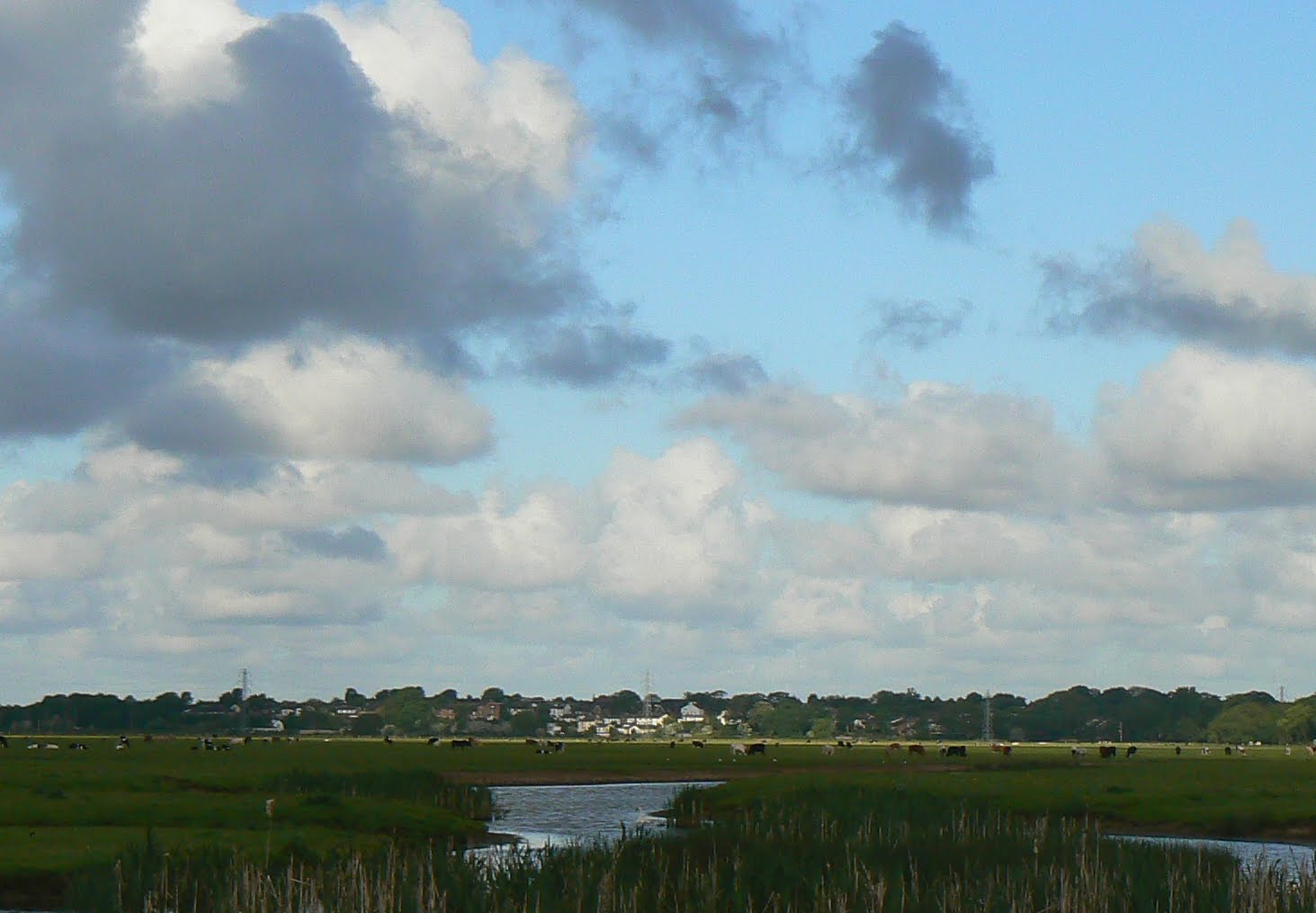
On the marsh (early)


The changing light always makes a visit worthwhile when 'nothing' else is happening. But there is always something when you look long and hard enough (not that I ever do!).

One of the few places you get such a long flat open vista. Incredibly 'members of the family' had cattle on this site over 300 years ago! Maybe I should give history a wave.
I am used to seeing Redshank on river estuaries, on the beach and they are remarkably well patterned for their environment. From above a raptor would have difficulty spotting this as a target.
Grey Partridge are difficult to approach literally running off as you approach, and if you get too close, zoom off at zero feet, putting any radar to shame!

Being in the right place at the right time helps, but it inevitably means an early start. The problem always is, the sun rises in the east EVERY DAY! (and strangely enough sets in the west, funny that).
Sometimes understanding bird behaviour helps, adult lapwings attacking approaching gulls can be a sign that youngsters are not far away. Of course this dull black birds have much more going for them than one realise, the irridescence created by light reflection and all that. As a young lad, I have abiding memories of seeing a lapwing nest with three eggs in the dip in the ground created by cattle feet, when off into the countryside very early one morning — a long long time ago — needless to say that field is now housing. Gotta live somewhere I guess.
Corvids, Rooks, Carrion Crows and Magpies can be a problem, as indeed predatory gulls, but sometimes even they are pre-occupied, this magpie busy collected worms for the offspring.


Sunday, 16 May 2010

One of those evenings

One of those nights when the light was fading and it was a quick visit.

Redshank were present and Moorhen fighting until big brother the Coot came along and split them up. The male Gadwall was on his own and he looked sorry for himself. I'm not sure if she has been lost or is nesting somewhere. May have gone off with someone else! I attach a rather poor record shot of the Little Grebe, just so you know there is a pair on site, honest!

Again a pair of Godwit were around the margins but it was too dark to obtain a photo, the sun casting long dark shadows. The lapwing was in the winter wheat field and subsequently raised a brood here. A few weeks later, I watched with great trepidation as the parents led them across the road, with 32 tonners hurtling along! (I ended up playing some sort of school crossing warden, advising a couple of cars of the circumstances. A pair of Grey Wagtails pooped in for a wash and brush up as the sun set. (too much 'ello 'ello!)

On the fence a male Linnet was looking singing away, protecting his territory and looking after his Mrs who was feeding on the dandelion seed heads.